
MultiagentFinal
This was my final project for Multi-Agent Foundations. The report studies a stricter two-agent Sokoban benchmark and asks how communication, intent grounding, and recurrent memory help decentralized agents coordinate under partial observation.
The code repository is not public yet, so I keep the course report as the public artifact for now: Strict Cooperative Sokoban report.
Course project framing
The report is titled Strict Cooperative Sokoban: Intent-Grounded Recurrent Communication for Partially Observable MARL. The starting point is a small but consequential environment issue: in a common 9-action cooperative Sokoban interface, a push action into empty space can also move the agent. That creates action aliasing. The same physical transition may be labeled as either a move or a push, and valid-action masks become ambiguous.
I define this project around removing that ambiguity. In StrictCoop-Sokoban, push actions move the agent only when they actually displace a box. Navigation must use move actions. That makes behavior-cloning labels identifiable and makes action masks semantically clean.
Benchmark design
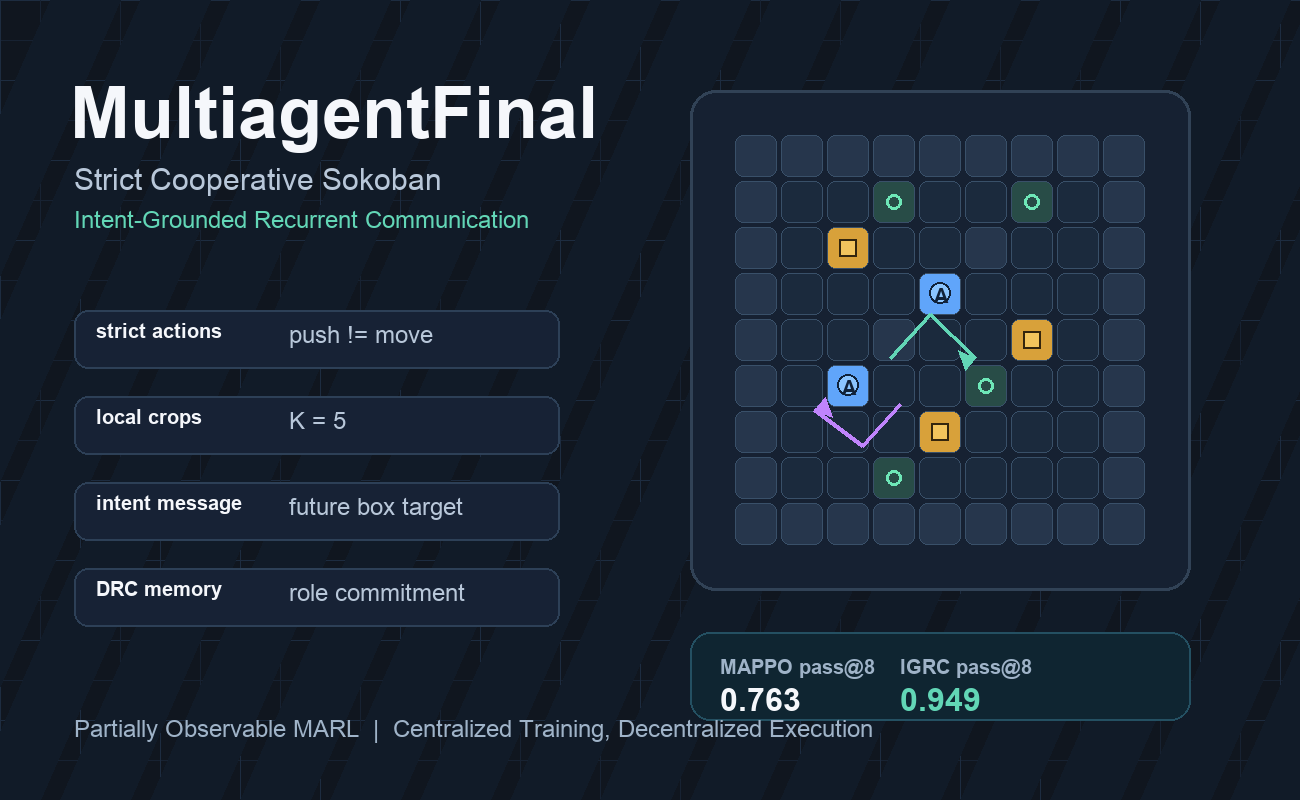
The benchmark uses fixed two-agent Sokoban levels with shared reward, local observations, strict push semantics, planner-verified train and evaluation pools, and a disjoint hard split. The main v2 setting uses a 10 by 10 grid, two agents, three boxes, and local (K=5) crops. This means each agent often cannot see the whole puzzle, all boxes, or the other agent.
That partial observability is the real coordination pressure. An agent has to choose a compatible role, remember which box it intends to move, infer the partner’s likely role, and avoid irreversible pushes. The hard evaluation levels are not hand-picked demos; they come from random wall construction followed by planner verification and are filtered by solution length.
Method
The baseline family is MAPPO-style centralized training with decentralized execution. In this setting, parameter-shared MAPPO is a strong standard baseline, which is useful because it gives the project a meaningful comparison point rather than a weak strawman.
The proposed model is IGRC-MAPPO: Intent-Grounded Recurrent Communication MAPPO. It adds three ingredients:
- a low-dimensional broadcast intent message between agents
- an auxiliary future-box target that grounds the message in task-level intent
- a DRC-style ConvLSTM recurrent actor that preserves role commitment across environment steps
The auxiliary label comes from planner trajectories: for each agent and time step, the target is the first box the agent will push within a short horizon, or a no-target sentinel. This pressures the message to represent cooperative intent instead of becoming an unconstrained hidden feature.
What the experiments show
On the fixed v2 hard split, MAPPO is the strongest standard baseline in the report, reaching (0.763 \pm 0.012) pass@8. The final IGRC-MAPPO encoder-128 model reaches (0.949 \pm 0.015) pass@8 and (0.973 \pm 0.014) pass@16 across three seeds.
The ablations are more important than the headline number. Communication alone improves stateless MAPPO. Auxiliary grounding changes the retry distribution and gives the message a task-level meaning. The largest jump appears when cross-step recurrent memory is added. A reset-each-step ConvLSTM ablation keeps extra per-frame computation but loses persistent state, and its lower pass@8 supports the interpretation that memory, not just capacity, is carrying much of the improvement.
Moderate encoder scaling helps, but raw capacity is not a monotonic solution. The encoder-128 model outperforms a larger encoder-512 variant in the current experiments. I read that as a warning against describing the result as “bigger model wins.” In this benchmark, the useful inductive bias is closer to stable intent plus memory.
What I learned
This project made multi-agent coordination feel less like a slogan and more like an interface problem. Before asking whether agents can communicate, the environment has to make actions mean exactly one thing. Before trusting a message channel, I want to know what the message is being pressured to represent. Before attributing a gain to architecture size, I want an ablation that separates computation from memory.
The result is still course-project evidence, not a finished MARL benchmark paper. But it gives me a clean lesson I want to keep: in partially observable cooperative tasks, robust behavior often depends on preserving intent across time, not only on reacting well to the current local crop.
